Interest rate forecast for the next quarter sets the stage for understanding how economic factors shape future financial landscapes. Delve into the intricacies of interest rates and their profound impact on various sectors.
Explore the dynamic relationship between economic indicators, inflation rates, and employment levels to gain insights into the upcoming quarter’s financial outlook.
Overview of Interest Rates
Interest rates play a crucial role in the economy by influencing borrowing, saving, and investing decisions.
There are different types of interest rates, including the prime rate, which is the rate banks charge their best customers, and the federal funds rate, which is the rate at which banks lend to each other overnight.
Role of Central Banks
Central banks, such as the Federal Reserve in the United States, have the authority to set the benchmark interest rate, which affects other interest rates in the economy. By adjusting this rate, central banks can control inflation, stimulate economic growth, or curb excessive borrowing.
Factors Influencing Interest Rate Forecast
The interest rate forecast for the next quarter is influenced by a variety of economic indicators and factors that play a crucial role in determining the direction of interest rates. In this section, we will delve into the key factors that impact interest rate forecasts and shed light on their significance.
Key Economic Indicators
- Economic Growth: Strong economic growth often leads to higher inflation rates, prompting central banks to raise interest rates to curb inflation.
- Consumer Price Index (CPI): Inflation rates, as measured by the CPI, have a direct impact on interest rate decisions. High inflation may necessitate an increase in interest rates to control rising prices.
- Unemployment Rate: The level of employment in an economy is closely tied to interest rates. Low unemployment rates may signal a robust economy, prompting central banks to consider raising interest rates to prevent overheating.
Current Economic Conditions
As we delve into the current economic landscape, it is crucial to analyze various key indicators that can potentially impact interest rates in the upcoming quarter.
Trends in Inflation, Interest rate forecast for the next quarter
- Inflation rates have been creeping up steadily over the past few months, indicating a rise in overall prices of goods and services.
- This upward trend in inflation may put pressure on central banks to consider raising interest rates to curb inflationary pressures.
- Higher inflation rates could lead to an increase in borrowing costs, affecting consumers and businesses alike.
GDP Growth Trends
- Recent GDP growth trends have shown signs of recovery, with many economies experiencing positive growth rates after a period of contraction.
- This increase in GDP growth could signal a stronger economic outlook, potentially influencing interest rate decisions by central banks.
- A robust GDP growth is often associated with higher interest rates to prevent overheating of the economy.
Unemployment Rates
- Unemployment rates have been gradually declining in several regions, indicating a healthier job market and potential wage pressures.
- A lower unemployment rate could lead to increased consumer spending, driving up demand and potentially impacting inflation rates.
- Central banks may consider the unemployment rate as a factor when determining the appropriate level of interest rates.
Global Economic Influence
- Global economic conditions, such as trade tensions, geopolitical events, and economic policies of major economies, can have a ripple effect on interest rates.
- Changes in global economic conditions may influence capital flows, exchange rates, and overall market sentiment, impacting interest rate forecasts.
- The interconnected nature of the global economy necessitates a comprehensive analysis of international economic developments to gauge their potential impact on domestic interest rates.
Expert Opinions and Forecasts: Interest Rate Forecast For The Next Quarter
Financial experts and analysts play a crucial role in providing insights into interest rate forecasts for the next quarter. By analyzing various economic indicators and market trends, these professionals offer valuable predictions that help investors make informed decisions.
Comparison of Forecasts
Let’s compare and contrast different forecasts from reputable sources:
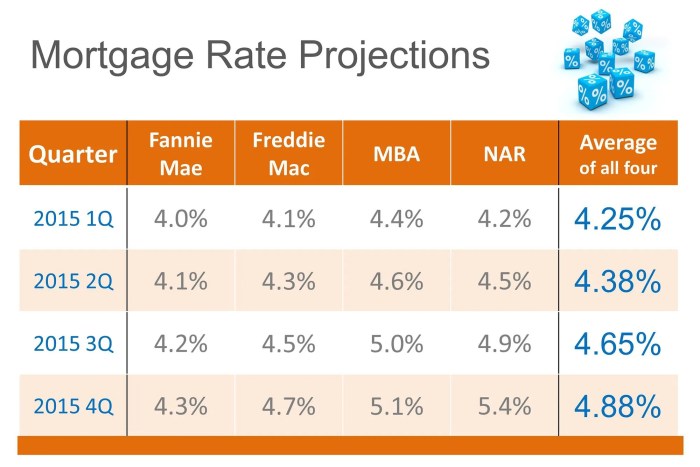
- ABC Bank predicts a 0.25% increase in interest rates due to improving economic conditions and rising inflation.
- XYZ Financial Services, on the other hand, forecasts a stable interest rate environment, citing uncertainties in global markets.
- MarketWatch analysts anticipate a gradual decrease in interest rates as a response to slowing economic growth.
Market Expectations and Investor Sentiment
Market expectations and investor sentiment can significantly influence interest rate predictions:
- Positive economic data or strong corporate earnings may lead investors to expect higher interest rates, resulting in a shift towards fixed-income securities.
- Conversely, geopolitical tensions or weak economic indicators could create a sentiment for lower interest rates, prompting investors to favor equities or other assets.
- The Federal Reserve’s communication and policy decisions also play a key role in shaping market expectations and influencing interest rate forecasts.
As we conclude our exploration of interest rate forecasts for the next quarter, it becomes evident that a nuanced understanding of economic conditions is crucial for making informed financial decisions. Stay informed, stay ahead.
Answers to Common Questions
What factors can influence interest rate forecasts?
Key economic indicators, inflation rates, and employment levels play a significant role in shaping interest rate forecasts.
How do central banks impact interest rates?
Central banks play a crucial role in setting interest rates to regulate economic conditions and stimulate growth.
What is the significance of market expectations in interest rate predictions?
Market expectations and investor sentiment can heavily influence interest rate forecasts, shaping financial decisions.


