
Historical interest rate trends reveal fascinating insights into the financial world. From the influence of central banks to the cyclical nature of rates, the past shapes our financial present and future.
Historical Interest Rate Trends
Historical interest rate trends refer to the patterns and fluctuations in interest rates over a significant period of time. These trends are crucial for understanding the behavior of interest rates in the past and predicting potential future movements.
Key Factors Influencing Interest Rate Trends
- Economic Conditions: The overall state of the economy, including inflation rates, unemployment levels, and GDP growth, can heavily influence interest rates.
- Central Bank Policies: Decisions made by central banks regarding monetary policy, such as adjusting the federal funds rate, can impact interest rates across the board.
- Market Expectations: Anticipated changes in the economy, inflation, or government policies can lead to shifts in interest rates as investors adjust their expectations.
Significance of Studying Historical Interest Rate Trends
Studying historical interest rate trends is essential for financial analysis as it provides valuable insights into how interest rates have responded to various economic conditions and events in the past. By analyzing these trends, analysts and investors can make more informed decisions regarding investments, loans, and overall financial planning.
Examples of Historical Impact on Economies
During the Great Depression in the 1930s, central banks around the world drastically reduced interest rates to stimulate economic growth and encourage borrowing. This historical event demonstrates how interest rate trends can be used as a tool to combat economic downturns.
In the 1980s, the United States experienced a period of high inflation, prompting the Federal Reserve to raise interest rates significantly to curb inflation. This decision had a profound impact on the economy, leading to a recession but ultimately stabilizing prices.
Interest Rate Influencers
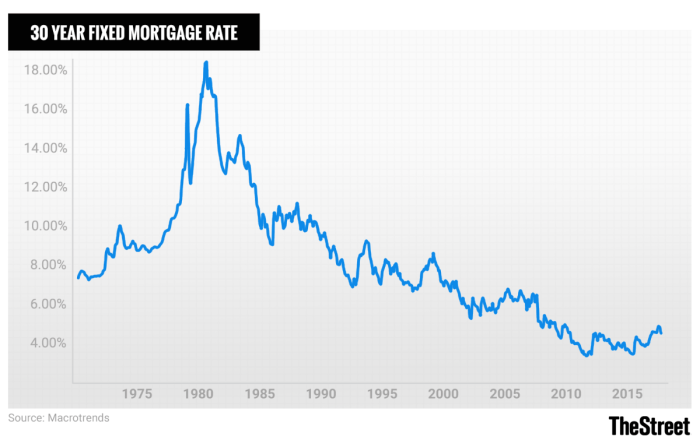
Interest rates are influenced by various factors that have evolved over time. Central banks, inflation, government policies, and external factors all play a crucial role in shaping historical interest rate trends.
Central Banks Influence
Central banks have a significant impact on interest rates through their monetary policy decisions. By adjusting key interest rates like the federal funds rate, central banks can influence borrowing costs for consumers and businesses. For example, when central banks raise interest rates, borrowing becomes more expensive, which can help control inflation but may slow down economic growth. Conversely, lowering interest rates can stimulate borrowing and spending, boosting economic activity but potentially leading to higher inflation.
Inflation Impact
Inflation is closely linked to interest rates, as rising prices erode the purchasing power of money. To combat inflation, central banks may raise interest rates to reduce spending and investment. Historically, periods of high inflation have been associated with higher interest rates to curb rising prices. Conversely, during times of low inflation or deflation, central banks may lower interest rates to stimulate economic activity.
Government Policies Role
Government policies also play a crucial role in shaping historical interest rate trends. Fiscal policies, such as government spending and taxation, can impact the overall economy and influence interest rates indirectly. For example, expansionary fiscal policies that increase government spending can lead to higher inflation, prompting central banks to raise interest rates. Additionally, regulatory policies can affect lending practices and interest rate levels in financial markets.
External Factors Examples
External factors, such as geopolitical events, global economic conditions, and market sentiment, can also affect interest rates. For instance, uncertainty surrounding trade agreements or political instability can lead to fluctuations in interest rates as investors seek safe-haven assets. Changes in global economic growth or commodity prices can impact interest rates as well, reflecting shifts in market dynamics and investor confidence.
Historical Interest Rate Patterns
Understanding historical interest rate patterns can provide valuable insights into the cyclical nature of interest rate trends and their impact on the economy.
Cyclical Nature of Interest Rate Trends
Historical data reveals that interest rates tend to fluctuate in cycles, moving up and down over time. These cycles can be influenced by various factors such as inflation, economic growth, and central bank policies. By analyzing these patterns, economists can better predict future interest rate movements and their potential impact on the economy.
Long-Term Historical Patterns
Over the long term, interest rates have shown patterns of rising during periods of economic expansion and falling during times of recession. These historical trends can help policymakers make informed decisions about monetary policy and guide investors in managing their portfolios.
Relationship with Economic Cycles
Historical interest rate patterns are closely linked to economic cycles. For example, during periods of economic growth, central banks may raise interest rates to curb inflation, while during recessions, they may lower rates to stimulate economic activity. Understanding this relationship can provide valuable insights into the broader economic landscape.
Predicting Future Trends
By studying historical interest rate patterns, analysts can develop models and forecasts to predict future trends. These predictions can help businesses and individuals make informed decisions about borrowing, investing, and saving, taking into account the potential impact of interest rate movements on their financial well-being.
Impact on Investments and Borrowing
Interest rate trends have a significant impact on both investment decisions and borrowing costs. Investors closely monitor interest rates as they can influence the performance of various asset classes and ultimately affect returns on investment. On the other hand, borrowers are also affected by interest rate fluctuations as they determine the cost of borrowing money.
Historical Impact on Investment Decisions, Historical interest rate trends
Interest rate trends play a crucial role in shaping investment decisions across different asset classes. For example, when interest rates are low, investors tend to seek higher returns by investing in riskier assets such as stocks or real estate. Conversely, when interest rates are high, investors may opt for safer investments like bonds or certificates of deposit. The historical data shows a clear correlation between interest rate trends and investment performance, highlighting the importance of monitoring interest rates in making informed investment decisions.
Historical Impact on Borrowing Costs
Historically, fluctuations in interest rates have had a direct impact on borrowing costs for individuals and businesses. When interest rates are low, borrowing becomes more affordable, leading to increased spending and economic growth. Conversely, high-interest rates can deter borrowing and slow down economic activity. For example, during periods of high interest rates in the past, mortgage rates were elevated, making it more expensive for individuals to finance home purchases.
Examples of Historical Impact on Asset Classes
Different asset classes have been affected by historical interest rate trends in various ways. For instance, bonds have an inverse relationship with interest rates, meaning that bond prices tend to fall when interest rates rise. On the other hand, stocks may perform well during periods of low-interest rates as companies can borrow money at cheaper rates to fund expansion. Real estate is another asset class that is influenced by interest rates, with low rates often leading to increased demand for housing and higher property prices.
Correlation Between Interest Rate Trends and Investment Performance
Analyzing historical data reveals a strong correlation between interest rate trends and investment performance. For example, during periods of economic expansion when interest rates are rising, stocks have historically outperformed bonds. Conversely, during economic downturns when interest rates are falling, bonds have shown better performance compared to stocks. Understanding this correlation can help investors make strategic investment decisions based on the prevailing interest rate environment.
Exploring historical interest rate trends provides a roadmap to understanding economic shifts and predicting future trends, making it a valuable tool for financial analysis and decision-making.
Question Bank
How do historical interest rate trends impact current financial decisions?
Historical interest rate trends can influence investment strategies and borrowing costs, guiding financial decisions in the present.
What role do external factors play in shaping historical interest rate trends?
External factors such as geopolitical events and technological advancements can have significant impacts on historical interest rate trends.


