
Understanding central bank interest rates plays a pivotal role in shaping a country’s economic landscape. From influencing borrowing to impacting investments, these rates are a key indicator of financial stability and growth.
Delving deeper into the world of central bank interest rates unveils a complex web of interconnected factors that drive monetary policies across different nations.
Introduction to Central Bank Interest Rates
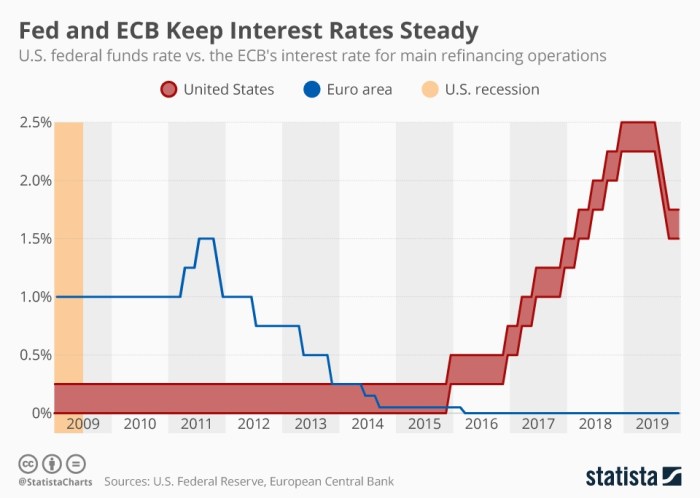
Central bank interest rates refer to the benchmark rates set by a country’s central bank, which influence the cost of borrowing money for banks and other financial institutions. These rates play a crucial role in the country’s monetary policy, affecting various economic factors such as inflation, employment, and economic growth.
Role of Central Bank Interest Rates in Monetary Policy
Central banks use interest rates as a tool to regulate the money supply in the economy. By increasing or decreasing interest rates, central banks can influence borrowing and spending behavior, ultimately impacting economic activity. For instance, lowering interest rates can stimulate borrowing and investment, leading to increased consumer spending and economic growth. Conversely, raising interest rates can help control inflation by reducing spending and borrowing.
Examples of Central Banks and Their Interest Rate Decisions
- The Federal Reserve (Fed) in the United States sets the federal funds rate, which influences short-term interest rates in the country.
- The European Central Bank (ECB) determines the main refinancing rate for the Eurozone, affecting borrowing costs for member countries.
- The Bank of England sets the Bank Rate, guiding interest rates in the UK and impacting consumer borrowing and spending.
Factors Influencing Central Bank Interest Rates
When central banks make decisions regarding interest rates, they take into account various economic indicators to ensure stability and growth in the economy. Factors such as inflation, employment, and economic growth play a crucial role in determining the appropriate interest rate levels.
Economic Indicators Considered by Central Banks
- Inflation Rate: Central banks closely monitor the inflation rate as it reflects the general increase in prices of goods and services. High inflation may prompt central banks to raise interest rates to curb excessive spending and stabilize prices.
- Employment Levels: The employment rate indicates the health of the labor market. Central banks aim to achieve full employment by adjusting interest rates to stimulate job creation and economic growth.
- Economic Growth: Central banks assess the overall economic performance, including GDP growth, to determine the appropriate level of interest rates. Strong economic growth may lead to higher interest rates to prevent overheating of the economy.
Comparison of Prioritization by Different Central Banks
- The Federal Reserve (Fed) in the United States often places a strong emphasis on employment levels when setting interest rates, aiming to achieve maximum employment alongside price stability.
- The European Central Bank (ECB) focuses more on controlling inflation to ensure price stability within the Eurozone, adjusting interest rates accordingly.
- The Bank of England considers a balanced approach, taking into account both inflation and economic growth when making decisions on interest rates.
Impact of Central Bank Interest Rates on the Economy
Central bank interest rates play a crucial role in shaping the overall economy of a country. Changes in these rates can have far-reaching effects on borrowing, spending, and investment activities, influencing the economic landscape in various ways.
Effect on Borrowing, Understanding central bank interest rates
When central bank interest rates are lowered, borrowing becomes cheaper as commercial banks also reduce their lending rates. This encourages individuals and businesses to take out loans for various purposes, such as buying homes or expanding their operations. On the other hand, when central bank interest rates are raised, borrowing becomes more expensive, leading to a decrease in borrowing activities.
Effect on Spending
Lower central bank interest rates typically lead to increased consumer spending, as individuals have more disposable income due to lower loan repayments. This boost in spending can stimulate economic growth and drive demand for goods and services. Conversely, higher interest rates can dampen consumer spending as borrowing costs increase, leading to a slowdown in economic activity.
Effect on Investment
Changes in central bank interest rates also impact investment decisions made by businesses. Lower interest rates can make it more attractive for companies to borrow money to fund expansion projects or invest in new equipment. Conversely, higher interest rates can deter businesses from taking on additional debt, potentially slowing down investment activities.
Examples of Historical Events
- During the 2008 financial crisis, central banks around the world drastically lowered interest rates to stimulate economic growth and prevent a complete collapse of the financial system.
- In 2015, the Federal Reserve in the United States raised interest rates for the first time in nearly a decade, signaling confidence in the country’s economic recovery but also causing volatility in financial markets.
Reaction of Consumers, Businesses, and Financial Markets
Consumers tend to react positively to lower interest rates, as they can access cheaper credit for purchases like homes and cars. Businesses may increase investment and expansion plans in response to lower rates, while financial markets often experience volatility and fluctuations in asset prices following central bank interest rate adjustments.
Understanding Interest Rates: Understanding Central Bank Interest Rates
Interest rates play a crucial role in the economy, influencing borrowing, saving, and investment decisions. These rates represent the cost of borrowing money or the return on savings and investments.
Relationship Between Central Bank Interest Rates and Other Interest Rates
Central bank interest rates, often referred to as the benchmark rate, serve as a guide for other interest rates in the economy. When the central bank changes its rates, it can impact the rates offered by commercial banks, affecting various financial products and services.
Types of Interest Rates and Connections to Central Bank Rates
- Prime Rate: The prime rate is the interest rate that commercial banks charge their most creditworthy customers. It is typically linked to the central bank’s benchmark rate, with changes in the prime rate reflecting changes in the overall interest rate environment.
- Mortgage Rates: Mortgage rates are the interest rates applied to home loans. These rates are influenced by various factors, including the central bank’s policy decisions, economic conditions, and inflation expectations.
- Bond Yields: Bond yields represent the return an investor can expect from investing in bonds. Central bank interest rate changes can impact bond yields, especially for fixed-income securities.
In conclusion, the intricate relationship between central bank interest rates and economic outcomes highlights the importance of understanding and monitoring these rates for a robust financial future.
User Queries
How do central bank interest rates impact everyday consumers?
Central bank interest rates can affect consumer spending and saving behavior by influencing the cost of borrowing and the returns on savings accounts.
What role do central bank interest rates play in controlling inflation?
Central bank interest rates are often used as a tool to control inflation by adjusting the cost of borrowing, which can impact consumer spending and overall demand in the economy.


